Month: March 2023

  • Unraveling the Potential of Oligonucleotides

    Unraveling the Potential of Oligonucleotides

    Advancing Research, Diagnostics, and Therapeutics

    Oligonucleotides are short chains of nucleic acids that are widely used in a variety of applications, including research, diagnostics, and therapeutics. These molecules consist of a series of nucleotides that are linked together by phosphodiester bonds, and they can be designed to bind specifically to target sequences of DNA or RNA.

    In recent years, advances in oligonucleotide synthesis and design have led to the development of new tools for genetic research and diagnostics. Here, we will explore some of the key applications of oligonucleotides, including how they are used to study gene expression and genetic variation, as well as their potential use in diagnosing and treating disease.

    Oligonucleotides in Research

    One of the most important applications of oligonucleotides is in genetic research. These molecules can be used to study gene expression, genetic variation, and other aspects of the genome.

    One common use of oligonucleotides is in microarray analysis. Microarrays are tools that allow researchers to measure the expression of thousands of genes simultaneously. To create a microarray, researchers synthesize oligonucleotides that are complementary to specific regions of the genome. These oligonucleotides are then printed onto a chip or slide, and labeled RNA or DNA samples are hybridized to the chip. By measuring the intensity of the hybridization signal, researchers can determine which genes are being expressed and at what levels.

    Oligonucleotides can also be used to study genetic variation. Single nucleotide polymorphisms (SNPs) are variations in the DNA sequence that occur when a single nucleotide is replaced with a different nucleotide. SNPs are the most common type of genetic variation in humans, and they can be used to study the genetic basis of disease and other traits. To detect SNPs, researchers can synthesize oligonucleotides that are specific to each allele (variant) of an SNP. By hybridizing these oligonucleotides to genomic DNA, researchers can determine which alleles are present in an individual.

    Oligonucleotides in Diagnostics

    In addition to their use in research, oligonucleotides are also being developed for use in diagnostics. One potential application is in the detection of infectious diseases.

    One example of this is the use of oligonucleotides in polymerase chain reaction (PCR) assays. PCR is a technique that allows researchers to amplify a specific region of DNA in order to detect the presence of a particular pathogen. To perform a PCR assay, researchers design two oligonucleotides that are complementary to regions flanking the target sequence. These oligonucleotides serve as primers, initiating the amplification of the target sequence. By using fluorescently-labeled oligonucleotides, researchers can monitor the progress of the amplification reaction in real time.

    Oligonucleotides can also be used in hybridization-based assays for the detection of pathogens. In these assays, oligonucleotides are synthesized that are specific to the target pathogen. These oligonucleotides are labeled with a fluorescent or radioactive tag and hybridized to genomic DNA, or RNA extracted from a patient sample. By detecting the presence of the labeled oligonucleotides, researchers can determine whether the target pathogen is present in the sample.

    Oligonucleotides in Therapeutics

    In addition to their use in research and diagnostics, oligonucleotides are also being developed as therapeutics. One of the most exciting recent developments in this area is the approval by the FDA of the first antisense oligonucleotide (ASO) therapy.

    One example of a FDA-approved oligonucleotide drug is Spinraza, which is used to treat spinal muscular atrophy (SMA), a genetic disorder that affects muscle strength and movement. Spinraza is an antisense oligonucleotide that targets a specific RNA molecule involved in the production of a protein critical for the survival of motor neurons. By binding to this RNA molecule, Spinraza can increase the production of the protein and improve motor function in patients with SMA.

    Another example of a promising oligonucleotide drug is patisiran, which was approved by the FDA in 2018 for the treatment of hereditary transthyretin amyloidosis (hATTR), a rare disease caused by the accumulation of misfolded proteins in various organs of the body. Patisiran is a small interfering RNA (siRNA) that targets the production of the protein responsible for accumulating misfolded proteins in hATTR. By reducing the production of this protein, patisiran can slow or even reverse the progression of the disease.

    These examples demonstrate the potential of oligonucleotide therapeutics to treat various genetic disorders. While there are still challenges to overcome, such as delivery and off-target effects, the development of FDA-approved oligonucleotide drugs is a promising step forward in the field of nucleic acid-based therapeutics.

    In conclusion, Oligonucleotides are versatile molecules that have a wide range of applications in research, diagnostics, and therapeutics. Their ability to specifically bind to target sequences of DNA or RNA has made them invaluable tools for studying gene expression, genetic variation, and pathogen detection. As the field of oligonucleotide synthesis and design continues to advance, it is likely that these molecules will become even more important in our efforts to understand and treat disease.

    Are you looking for high-quality oligonucleotides?

  • Moving from Column to Bead-Based Nucleic Acid Isolation

    Moving from Column to Bead-Based Nucleic Acid Isolation

    Purity, Efficiency, and Versatility

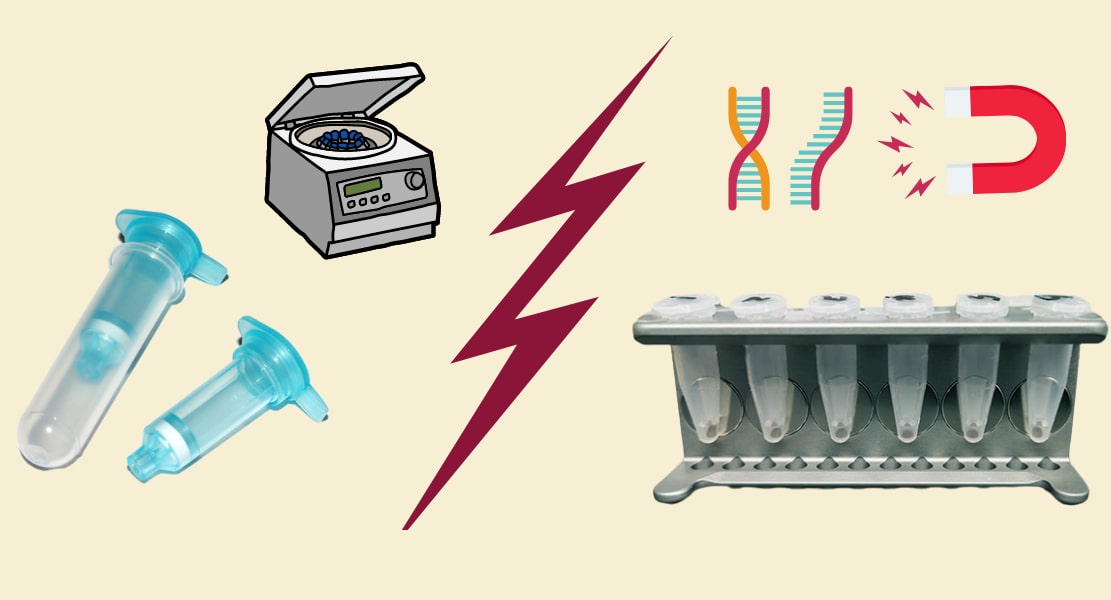
    Nucleic acid isolation is an essential step in molecular biology and genetic research. It involves extracting and purifying DNA or RNA from a sample of interest. Traditional nucleic acid isolation methods rely on spin-column technology, which uses silica-based columns to bind and purify nucleic acids. However, magnetic bead-based nucleic acid isolation methods have gained popularity in recent years due to their advantages over spin column methods. This article will discuss the benefits of switching from spin columns to magnetic bead-based nucleic acid isolation methods.

    Speed and Efficiency

    Magnetic bead-based nucleic acid isolation methods are faster and more efficient than traditional spin column methods. Magnetic beads have a larger surface area than silica-based columns, which allows for faster binding and elution of nucleic acids. Additionally, using magnetic beads allows for automation and high-throughput processing, making it ideal for laboratories that process large numbers of samples.

    Increased Yield and Purity

    Magnetic bead-based nucleic acid isolation methods provide higher yield and purity of nucleic acids compared to spin column methods. Magnetic beads have a high binding capacity, which ensures that all nucleic acids are captured and purified. Furthermore, magnetic bead-based methods use fewer chemicals and reagents, which reduces the risk of contamination and leads to higher purity of nucleic acids.

    Versatility

    Magnetic bead-based nucleic acid isolation methods are versatile and can be used for various applications, including DNA and RNA isolation, sequencing, and PCR. Using magnetic beads also allows for the isolation of nucleic acids from different sources, such as blood, tissue, and saliva. This makes it an ideal method for researchers working on various projects.

    Reproducibility and Consistency

    Magnetic bead-based nucleic acid isolation methods offer reproducibility and consistency in results. The use of automated magnetic bead-based systems ensures that each sample is processed in the same way, reducing the risk of experimental errors. Additionally, using standardized protocols and magnetic bead-based kits ensures that the results are consistent and reproducible.

    Cost-Effective

    Magnetic bead-based nucleic acid isolation methods are cost-effective in the long run. While the initial investment in magnetic bead-based systems may be higher than spin column methods, the use of magnetic beads allows for higher throughput and reduced processing time. This can lead to significant cost savings over time, especially for laboratories that process a large number of samples.

    Environmentally Friendly

    Magnetic bead-based nucleic acid isolation methods are more environmentally friendly than spin column methods. Magnetic beads are reusable and can be easily cleaned and sterilized, reducing the amount of waste generated. Additionally, the use of magnetic bead-based systems reduces the use of hazardous chemicals and reagents, making it a safer and more sustainable option.

    In conclusion, the advantages of switching from spin column to magnetic bead-based nucleic acid isolation methods are straightforward. Magnetic bead-based methods offer faster processing time, higher yield and purity, versatility, reproducibility and consistency, cost-effectiveness, and environmental sustainability. While spin column methods have been the traditional method for nucleic acid isolation, the benefits of magnetic bead-based methods make it an attractive alternative for researchers and laboratories looking to improve their nucleic acid isolation processes.